
The Spinning Wheel Distribution System
The struggle is real

Not unlike the Universal Cat Distribution System, once the universe decides you need a spinning wheel you will have wheels. They will show up without warning. This is also true for looms and other textile tools.1 Presently, I am the keeper of three functional treadle wheels, one antique great wheel, one modern great wheel, one antique Swiss lateral wheel (that is missing important parts) and uncountable numbers of spindles.
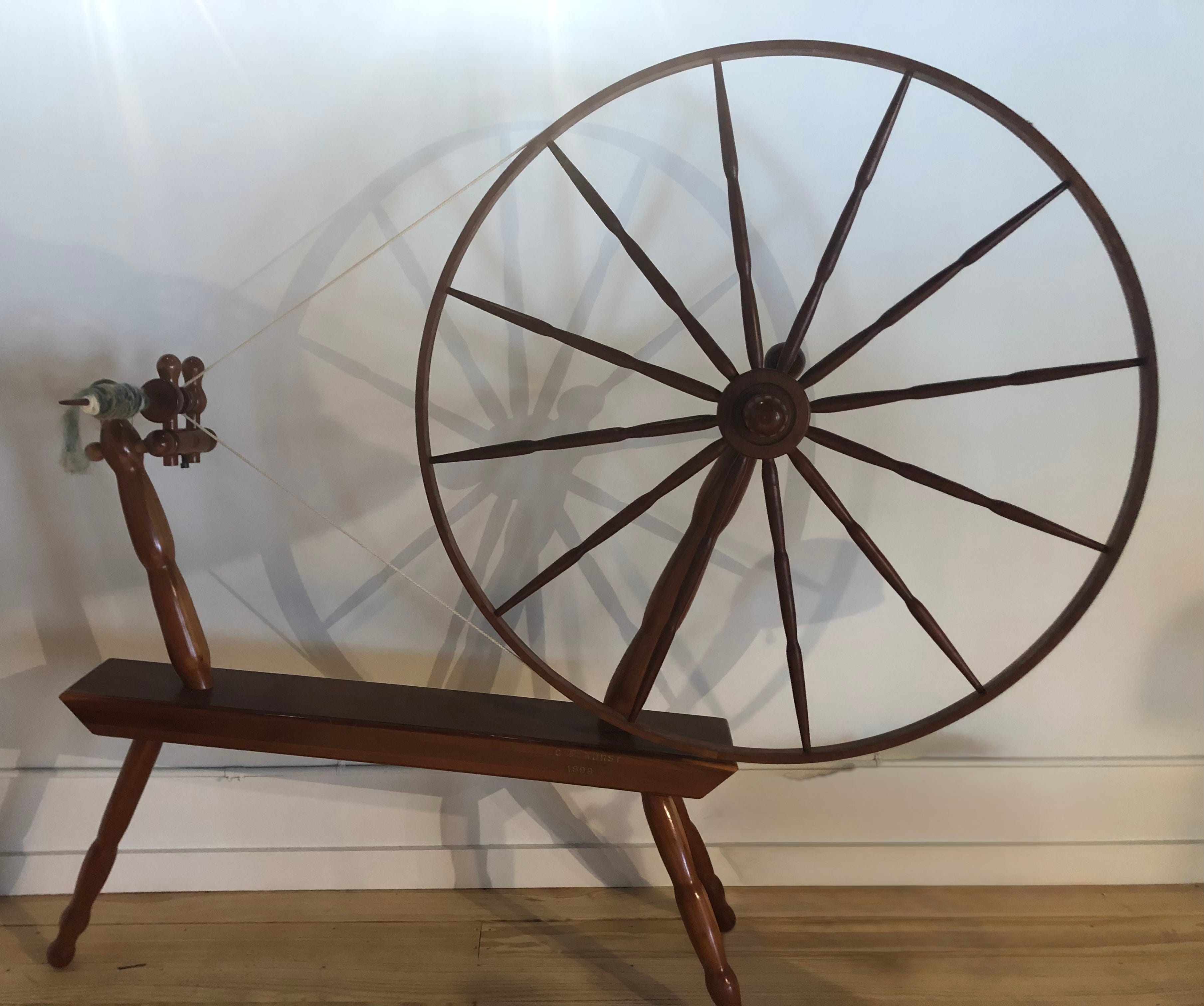
The Big One
My cousin, Walt, who worked in the antique business, called me in 2019 to tell me about a really big spinning wheel that was part of an art collector’s estate. It was not an antique, in fact, it was signed and dated 1999. The seller was asking $200, I offered $100 and bought it for $150. It is the one that has been upstairs at Oil and Cotton since 2021. Indestructible, kid-proof and a good, solid spinning wheel. I have not been able to learn much about its maker or history. The estate sale label said “Arkansas Wheel.” I think it might be modeled after the Rio Grand Wheel which was designed by Rachel Brown.2 It has some unique features such as a sealed ball-bearing housed inside the solid cone-shaped wooden spindle. The drive band is a solid polyester cord. This girl is great for funky art yarn and teaching beginners.


The Old One: 19th Century Cotton Wheel
I learned to use a Great Wheel at Old City Park in the 1980s because of the Dallas Hand Weavers and Spinners Guild. Emily Walker met me at the dog-trot Cabin for lessons. I reciprocated by joining the group that demonstrated textile skills every month.
Emily called me one day to tell me that she had spotted a Great Wheel at an antique store in Dallas. She told it that it might be missing a few parts, “so look carefully at it and offer less than they are asking for it.” My mom went with me, and being my mom, paid for it.
When we got it home, we discovered all that it was missing was the leather3 loops that hold the spindle. I named her Gertie, after one of my Danish Aunts, and she has been my favorite for decades. Still works like a charm with an occasional coat of beeswax. 4


The Rick Reeves Castle Wheel
This wheel was made in Iowa by Rick Reeves5 a well respected wood worker and spinning wheel maker. I had the opportunity to visit his workshop in 1993. We did not have an appointment (or GPS) but used a paper map to find him. We asked the guy who was mowing the grass out front if we were at the right place, turns out it was Rick himself!
He made us welcome, introduced his wife and then gave us a tour of his workspace. He invited me to sit down and try some of the wheels on display. I was sold, but had to wait a few months before I could order one.
I was able to get this workhorse through Woolen Works in Lancaster, TX at a discount because it had been ordered by someone who changed their mind. She continues to be my go-to wheel.
The Clemes and Clemes Original
My friend, Victoria Owens, sent me a link to an FB Marketplace listing for this poor neglected wheel. I made arrangements to meet the (very sketchy) seller at his rural home which was also a permanent garage sale/flea market. I really could not afford it, but decided it needed to be brought back into the fold.
The entire surface was coated with a dark film, probably from being in a house with either a fireplace and/or a smoker for 40 years. Thankfully, the wood cleaned up easily and the wheel works perfectly. I love this wheel for its portability and cuteness. It includes a built-in bobbin holder ,which is so useful!
The Ashford Original
This beauty was a gift from Reid Barnhardt in 2024. She trusted me to get it into working order, and it was a fun project. Like so many legacy wheel makers one can procure parts, instructions, and guidance for all their products. It is much faster than any wheel I have used and is great for plying spindle-spun yarn! This one came with a small bobbin holder6 for plying.


The Time-Space Conundrum
To be honest, it is impossible to spin as often as I would like. Plus, I tend to use my spindles most often because they are portable and very low maintenance; no moving parts and no need to adjust the tension. Every now and then, nevertheless, it is fun to get into production mode, oil-up one of wheels and crank out some yardage.
I know it is possible to ply with a spindle, but I tend to rely on my wheel(s) for plying, sometimes using the bobbin holder on one wheel while I ply on the other.
I hope everyone post something in the comments about your spinning wheels!
Let’s enjoy our folly.
If/when you meet a seller to take possession of a wheel or loom, they will offer you a paint bucket full of wooden bits and bobs. Take the bucket! It will probably be some of the best textile tools you ever saw: shed sticks, lease sticks, shuttles, tapestry looms, the possibilities are endless.
Rachel Brown is a weaving deity and her book has been my weaving guide for decades!
We followed a black & white photo in Spinning and Weaving with Wool by Paula Simmons. Since that time, I have learned about braided linen and straw loops for the spindle. I love the Great Wheel FB group for their kindness and their knowledge. It is a private group- but I can invite you if you are interested.
I have one more Old Girl, a Swiss Lateral Wheel given to me by Misti Grey. She needs some small parts to be functional.
Here is a fitting tribute to Rick Reeves
I am not sure why a bobbin holder or bobbin rack is called a Lazy Kate in the same way I cannot understand why the useful rotating spice holder is called a Lazy Susan. I do not approve of either term.
I spin with a drop spindle and pine over the day I have space for a spinning wheel like yours. For now, our little one bed apartment is filled to the gills with my looms (plural) as well as our bikes and my partner’s rowing machine !! Thank you for walking us through your collection. It is incredible.