
Return to Fairy Tales
The Prince who Married a Frog

The Prince Who Married a Frog
Italo Calvino is best known for his fabulous stories full of magical-realism. I am a vocal fan of all his works. I believe the foundation of his writing lies in the years he spent collecting folk tales throughout Italy. He published Italian Folktales in 1957. These tales are all related in many ways to other European Fairy Tales but quirkier and with less moralizing. Story #14 is called the Prince who Married a Frog, it follows a common folk-tale plot, but with a unique structure and attributes.
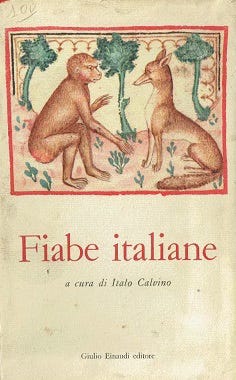
Here is part of the story:
There was once a king who had three sons of marriageable age. In order to avoid any dispute over their choice of three brides, he said, “Aim as far as you can with the sling. There where the stone falls you will get your wife.”
The three sons picked up their slings and shot. The oldest boy sent his stone flying all the way to the roof of a bakery, so he got the baker girl. The second boy released his stone, which came down on the house of a weaver. The youngest son’s stone landed in a ditch.
Immediately after the shots, each boy rushed off to his betrothed with a ring. The oldest brother was met by a lovely maiden as fresh as a newly baked cake, the middle brother by a fair girl with silky hair and skin, while the youngest, after looking and looking, saw nothing but a frog in that ditch.
They returned to the king to tell him about their betrothed. “Now,” said the king, “whoever has the best wife will inherit the kingdom. Here begin the tests.” He gave them each some hemp to be spun and returned within three days, to see which betrothed was the best spinner.
The sons went to their betrothed and urged them to spin their best. Highly embarrassed, the youngest boy took the hemp to the rim of the ditch and called:
“Frog, frog!”
“Who calls?”
“Your love who loves you not.”
“If you love me not, never mind. Later you shall, when a fine figure I cut.”
The frog jumped out of the water onto a leaf. The king’s son gave her the hemp, telling her he’d pick up the spun thread three days later.
Three days later the older brothers anxiously hastened to the baker girl and the weaver girl to pick up their spun hemp. The baker girl produced a beautiful piece of work; the weaver girl, who was an expert at this sort of thing, had spun hers to look like silk. But how did the youngest son fare? He went to the ditch and called:
“Frog, frog!”
“Who calls?”
“Your love who loves you not.”
“If you love me not, never mind. Later you shall, when a fine figure I cut.”
She jumped onto a leaf holding a walnut in her mouth. He was somewhat embarrassed to give his father a walnut while his brothers brought spun hemp. He nevertheless took heart and presented the king with the walnut. The king, who had already scrutinized the handiwork of the baker and the weaver girls, cracked open the walnut as the older brothers looked on, snickering. Out came cloth as fine as gossamer that continued to unroll until the throne room was covered with it. “But there’s no end to this cloth!” exclaimed the king. No sooner were the words out of his mouth than the cloth came to an end.
(The rest of the tasks also involve nut shells, and wins the youngest son the throne. Here’s a link to the whole story as well as the other tales!)
Calvino’s notes:
(Il principe che sposò una rana) from Comparetti, Monferrato, Piedmont.
The tale of the frog bride is common to all of Europe; scholars have counted 300 versions. Comparing it, for instance, with Grimm, no.63, or with Afanas’ev’s “The Frog Prince,” this variant which we can classify as distinctly Italian (since it shows up uniformly throughout the Peninsula, (even if slinging to locate the bride is rather rare) stands out in its near-geometrical logic and linearity.
Copyright: Italian Folktales Selected and Retold by Italo Calvino, 1946
translated by George Martin,
Pantheon Books, New York 1980
Hemp and not Flax?
Naturally, my favorite part is the spinning, so casually introduced. Not only is the chosen fabric hemp, but also, each potential princess has three days to turn the hemp into thread. Processing and spinning bast fibers is a time-consuming task, obviously, magic would be required to finish in three days.
Hemp, like other bast fibers, can be spun rather fine and light, but fine enough to be woven into yards of gossamer fabric which can be stored in a walnut shell? Sure, why not.
Hemp was domesticated as early as the 5th century BCE in Asia, and distributed as an agricultural crop westward to the Mediterranean and eventually into Northern Europe. Neolithic fabric samples are extremely rare and hard to identify, nevertheless, evidence of hemp seeds has been found in many sites. The production of fabric from hemp is mentioned in some of the Ancient Greek and Roman histories, too.1
Just as it is today, hemp was grown for the hallucinogenic properties of the leaves, nevertheless, it is also recorded as a bast fiber just as often. In fact, scraps of fabric found in early sites fibers can be recognizable as either plant-based or wool, but rarely can the fibers be distinguished between flax and hemp. That is to say, the two plants produce bast fibers that are alike in almost every way.
Fine as frog’s hair
There is an old saying, (first recorded in print in the mid-nineteenth century) “Fine as frog hair,” a humorous response to “How do you do?” Since there are few species of frogs that have hair, the term is obviously ironic.
However, the phrase (according to the Urban Dictionary) can also be used to describe something remarkable, beautiful and especially fine. Does this idea descend from the fairy tale? I would like to think so.
The Enchanted Amphibious Princess
Frogs are amphibians, creatures that live in a liminal space. In many traditions, they are not seen as loathsome, but messengers or totem figures. In this case, the solitary frog is a princess who has been enchanted and can’t be free unless she is offered marriage by a human. In some versions, there is an explanation as to why she is enchanted, but not the Italian version, she is simply who she is. Her skills are super-human, magical, and impressive. Her confidence in winning over the Prince is also admirable.
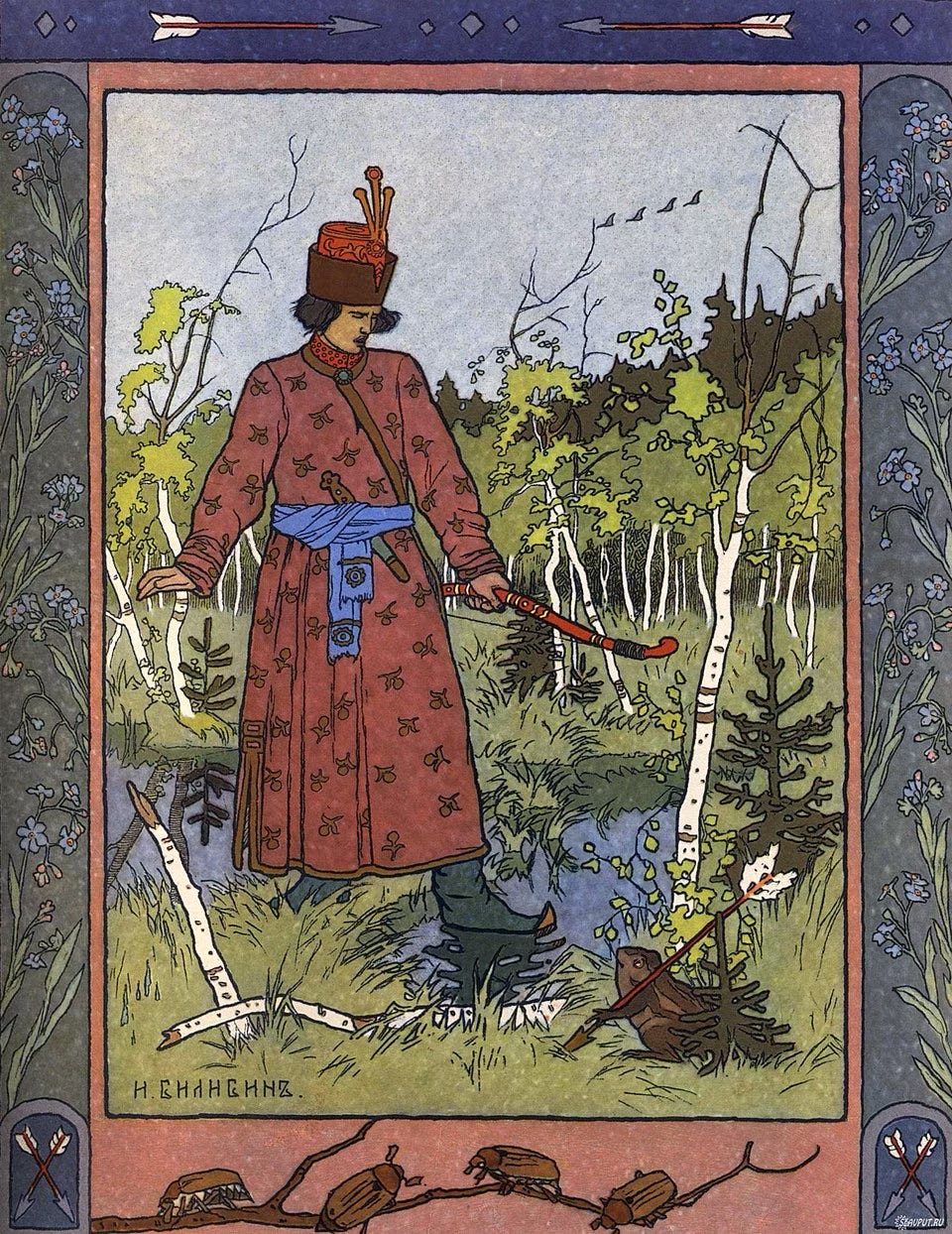
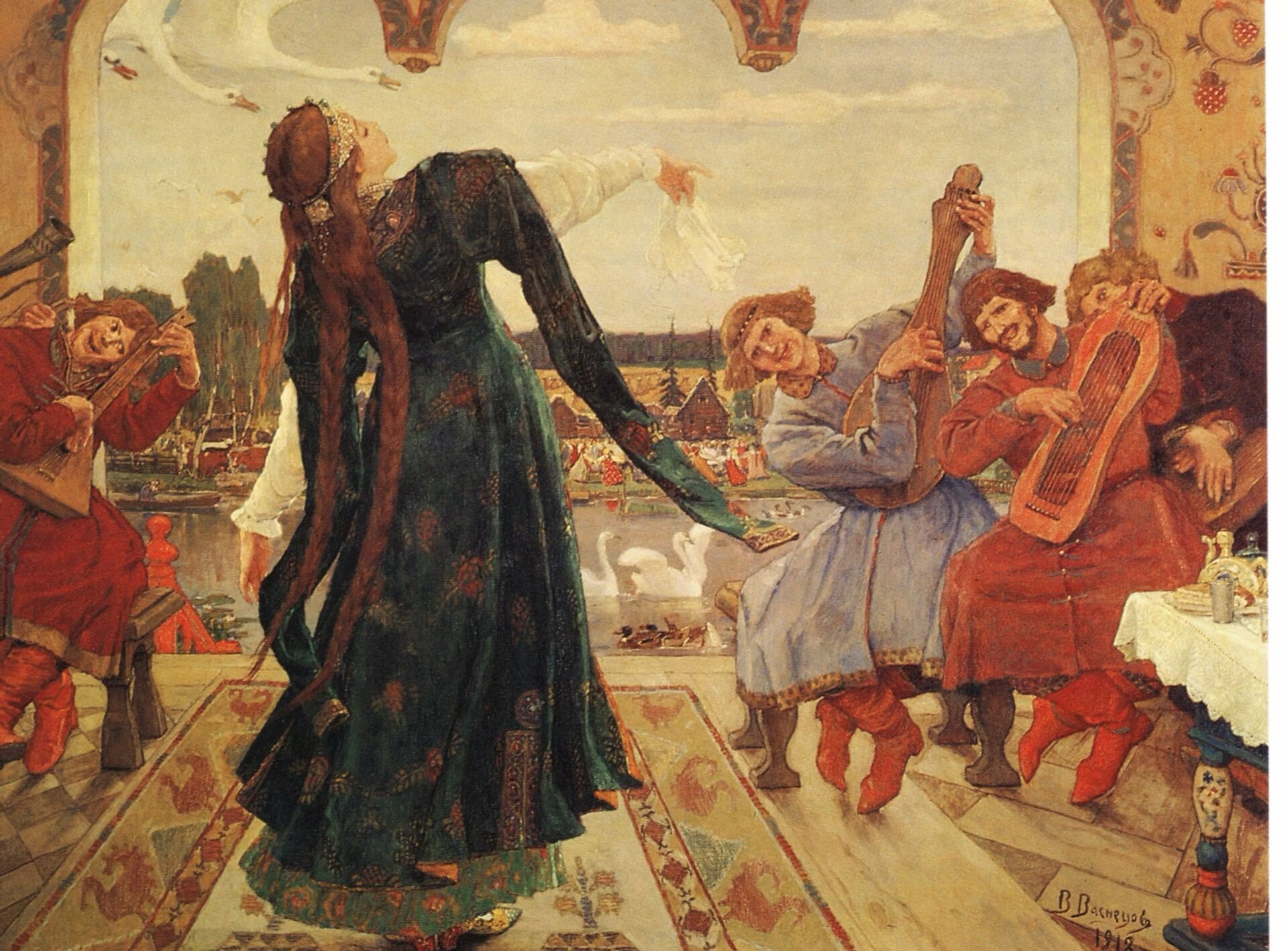
In the Russian version, not only is she a skilled spinner, weaver and baker but she dances so wonderfully that the Tsar offers his son’s hand in marriage.
In a Nutshell: Tiny Receptacles for Magical Fabric and Garments
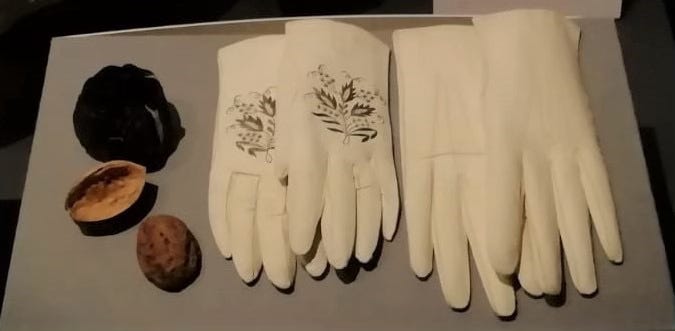
In many fairy tales, wonderful things (dresses, babies, dogs for example) are stored in nutshells. The nuts are often given to someone who is facing difficulties and the content of the nut is designed to fulfill a wish or a promise. As fantastic as this idea is, apparently things that fit in walnut shells include Limerick Gloves!2
Spin me a Yarn
I love folk tales, and the long history they hold in human history. Stories were, for ages transmitted across time and space, without being written down. The rise of printing presses and the Enlightenment, led to the publication of many stories (some based on old tales, some fabricated from whole cloth) that continue to enrich our lives. The fact that textiles are essential to most of these stories only makes it more interesting!
Thank you all for sticking with me and this blog, there are so many wonderful sources for learning about the history of humankind through the textile arts, I sometimes feel a little over whelmed. I am also thankful to Elizabeth Wayland Barber for opening the door to Textile History for all of us.
Barber, E.J.W. Prehistoric Textiles: The Development of Cloth in the Neolithic and Bronze Ages. Princeton University Press. 1991. pp 15-19
Fabulous. I need to read these stories.