
Remember the Ladies!
Revolutionary Textile History after 250 Years

Women’s Revolutionary Work
With the celebration of 250 years since the signing of the Declaration of Independence, I have been reflecting on the importance of textiles in the conflict between the American Colonies and England. There is much to discuss regarding liberty, human rights, and good governance; all as complicated today as it was in the 18th century.
Fifty years ago, when we celebrated the Bicentennial, I accumulated several books about women and their work from that era. These mostly reflect the experiences of upper and middle class women, most likely because these women wrote letters and kept journals at a much greater rate than working class or enslaved women.
Looking Back through a Singular Lense
Not all of the above-mentioned, well-intentioned books have aged well, the general tone is condescending and shallow. I could not quite place my finger on the issue until I reread the opening chapters in The Age of Homespun1 by Laura Thatcher Ulrich. She describes the Colonial Revival from 1800’s and paints a picture of the Mythology of The Age of Homespun as a symbol of sturdy self-sufficiency and honest labor.
American citizens, feeling the press of industrialization, and a growing national divide over slavery, felt a longing for simpler times. On August 14, 1851 The Reverend Horace Bushnell memorialized this myth when he spoke at the County centennial in Litchfield, Connecticut. His speech, circulated in print afterwards, laid the foundation for the perpetuation of this concept.
It is not the starred epitaphs of the Doctors of Divinity, the Generals, the Judges, the Honorables, the Governors, or even of the village notables called Esquires, that mark the springs of our successes and sources of our distinctions.These are rather the effects than causes; the spinning wheels have done a great deal more than these.
Horace Bushnell, The Age of Homespun
Spinning wheels, tools, uniforms, and textiles were brought out of storage and displayed as part of The Centennial Celebration all over the United States. These tableaus were often called New England Rooms. The shift to a focus on the labor of ordinary folks was partly in response to the rise of industrialism. Reverend Bushnell was not the only speaker to urge listeners to remember the Colonial Women, “to whom the music of the spinning wheel and the loom was more necessary than that of the piano or harpsichord.” 2
This praise for the anonymous laborers who cleared the forest and farmed the land, supplementing their progress with sturdy homespun fabric, is as mythical as any fairytale from the Old World. When European and English settlers began arriving in the Colonies, most were seeking fortune, many were looking for religious freedom, and some were escaping from unpleasant circumstances back home. Many came against their will. Fabric making at home, much like today, was undertaken for many reasons but not to replace the imported textiles found in every day use.
Household Tasks vs Profitable Business
During the Colonial Era, 1600- 1776, British law, and the nature of colonization kept the focus on extracting raw materials from the New World and trading those goods to the Home Country for finished products. There is evidence of spinning wheels and looms in probate records of well-to-do households in the 1700s and many farms, especially those established by European Immigrants, raised sheep and grew flax, generally for personal use or to barter for other necessities. Middle and Upper-class women would have invested their time in decorative items for the home, as a diversion or what we would call- a hobby.
In the early days of the American Revolutionary War there was a brief, but widely celebrated, flowering of homespun fabric, Spinning Bees, and other public demonstrations of independence from imported fabric. In most cases, the spinners were volunteers and the finished products were offered as auction items to raise funds. It would not be long before the cotton raised in the South, with unpaid labor, would be shipped to the northern states to be spun and woven in steam powered mills, operated by poorly paid women and children.
For his first inauguration, George Washington wore a brown wool suit made in Connecticut from US grown wool. I have to assume his silk stockings were imported.


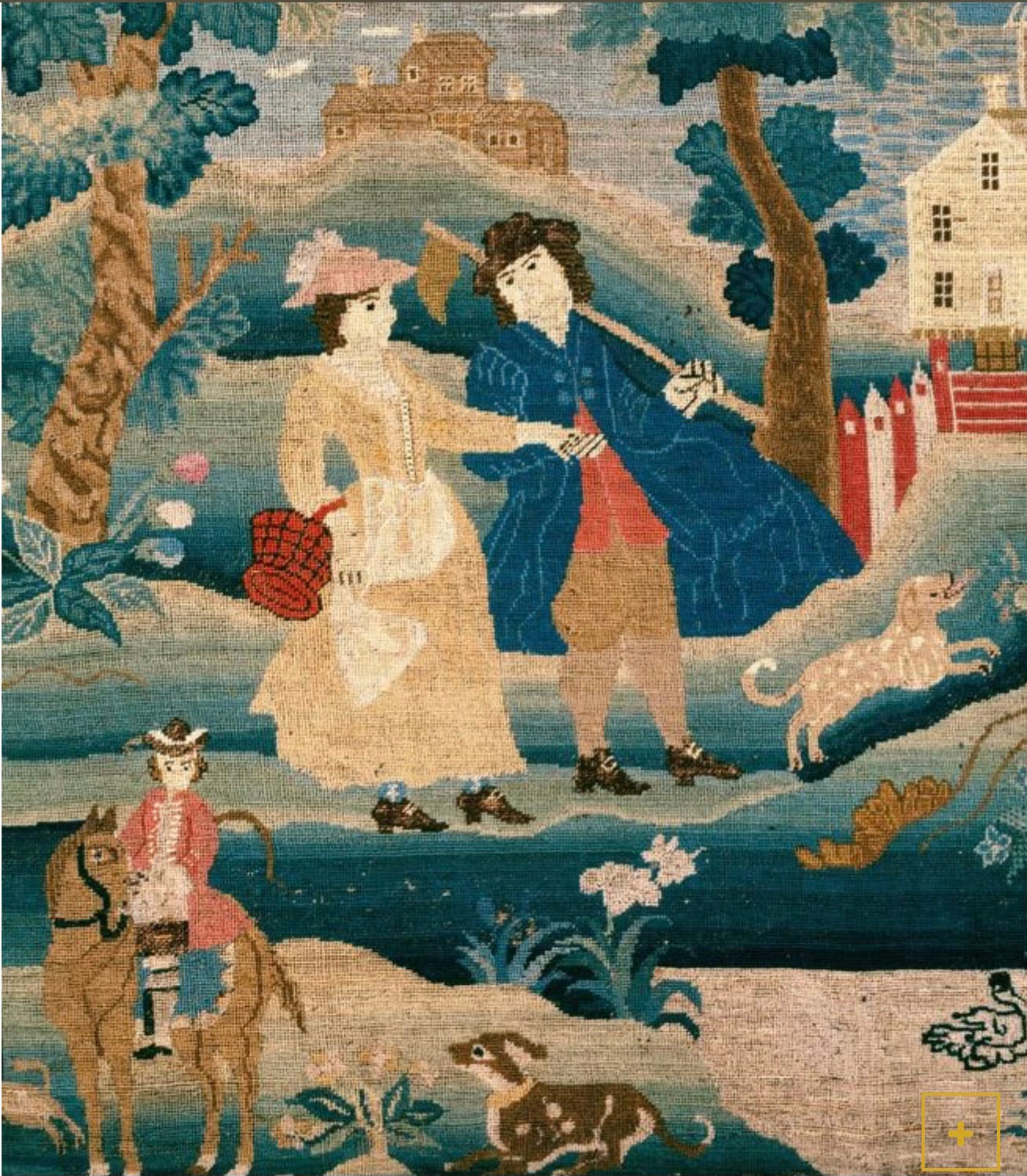
This needlework picture was made in Boston around 1750, depicts a pastoral setting with sporting people and animals (in every sense of the word). It is made from plant-dyed wool and silk on a linen fabric base.3
The Great American Myth in the 20th Century
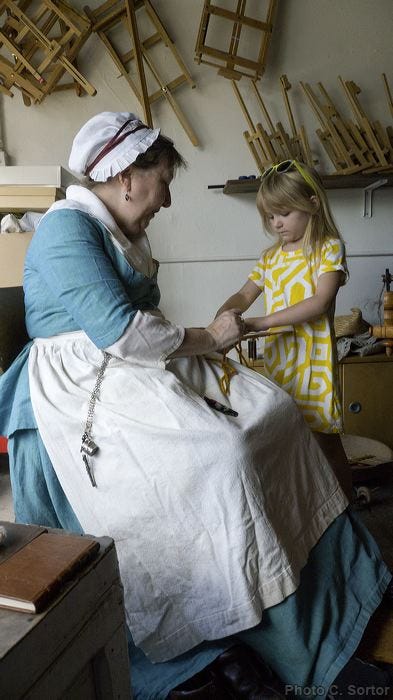
I admit to furthering this mythology, in past years, when I participating in 18th Century Living History events with my family. Public displays of Old Time Crafts continues to be an important part of culture in the USA. I have, over the years, used these the opportunities to acknowledge the cultural myth but also to speak about the role of indigenous and enslaved people, whose contribution to the Textile arts are finally being recognized. Books like The Age of Homespun, have helped me see that we have so much yet to learn.
Afterword from one the Founding Mothers
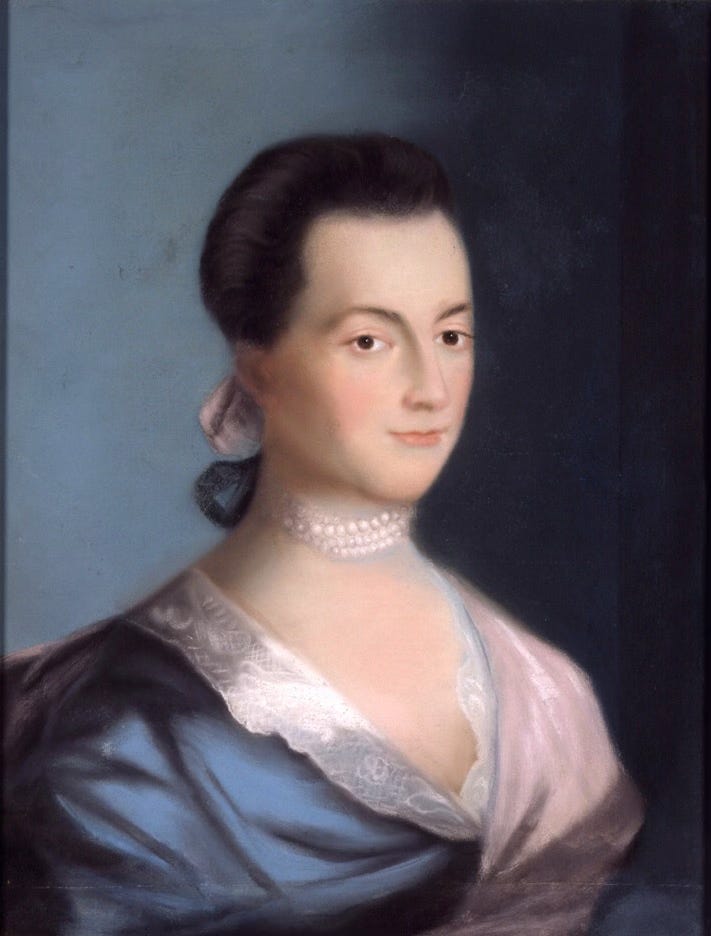
Abigail Adams sounds down right radical in her private letter to her husband. She understood that the role of women in the colonial economy laid the foundation for the ideas that engendered the call for Life, Liberty and Pursuit of Happiness. The foundation of the Declaration of Independence, laws, and the Constitution, lay in the labor (often unpaid) that built farms, towns and fortunes across the Nation.
Abigail Adam’s Letter to John Adams, dated March 31- April 5, 1776
I long to hear that you have declared an independency -- and by the way in the new Code of Laws which I suppose it will be necessary for you to make I desire you would Remember the Ladies, and be more generous and favourable to them than your ancestors. Do not put such unlimited power into the hands of the Husbands. Remember all Men would be tyrants if they could. If particuliar care and attention is not paid to the Ladies we are determined to foment a Rebellion, and will not hold ourselves bound by any Laws in which we have no voice, or Representation.
That your Sex are Naturally Tyrannical is a Truth so thoroughly established as to admit of no dispute, but such of you as wish to be happy willingly give up the harsh title of Master for the more tender and endearing one of Friend. Why then, not put it out of the power of the vicious and the Lawless to use us with cruelty and indignity with impunity.
Men of Sense in all Ages abhor those customs which treat us only as the vassals of your Sex. Regard us then as Beings placed by providence under your protection and in imitation of the Supreme Being make use of that power only for our happiness.
With a postscript:
You inquire of whether I am making Salt peter. I have not yet attempted it, but after Soap making believe I shall make the experiment. I find as much as I can do to manufacture clothing for my family which would else be Naked.
The Age of Homespun available on Bookshop. I recommend reading all her books, she is a true revolutionary in the art of extracting history from scraps and snippets. Much like my hero: Elizabeth Wayland Barber.
I am reminded of how important the piano and harpsichord were to the inhabitants of Jane Austen’s novels.
Chimneypiece from the Society for the Preservation of New England Antiquities
Wow the letter!! I love the feminism and especially the saltiness of this sentence- "for my family which would else be naked".