
It's a New Year!
whether we like it or not

Hello! It has been too long!!1
First, I was distracted by family needs, world events, and the holidays. Then on January 3rd,2 I was the presenter for the Dallas Hand Weavers and Spinning Guild. Needless-to-say, I took the assignment very seriously. The members of DHWSG are serious about the art and methods involved in Making Textiles. I am awestruck by the range of skills possessed by all the members and humbled by their kindness.
Because the Guild feels like a safe-haven, my presentation was focused on the long history of textiles among humans as a reflection of community values beyond productivity. I ended my talk with comments on importance of community as the world becomes more chaotic. When we spend time with people who share our interests (and share their skills) it provides an outlet for our worries as well as our need to care for others. Katherine Lines (president of DHWSG) described this as Civic Friendships and I like that idea.
THE SLIDE SHOW: ANNOTATED
The gist of my talk would be familiar to anyone who has taken a spinning workshop with me, but the big difference would be the addition of a slide show.
I went all out on the title of my talk:
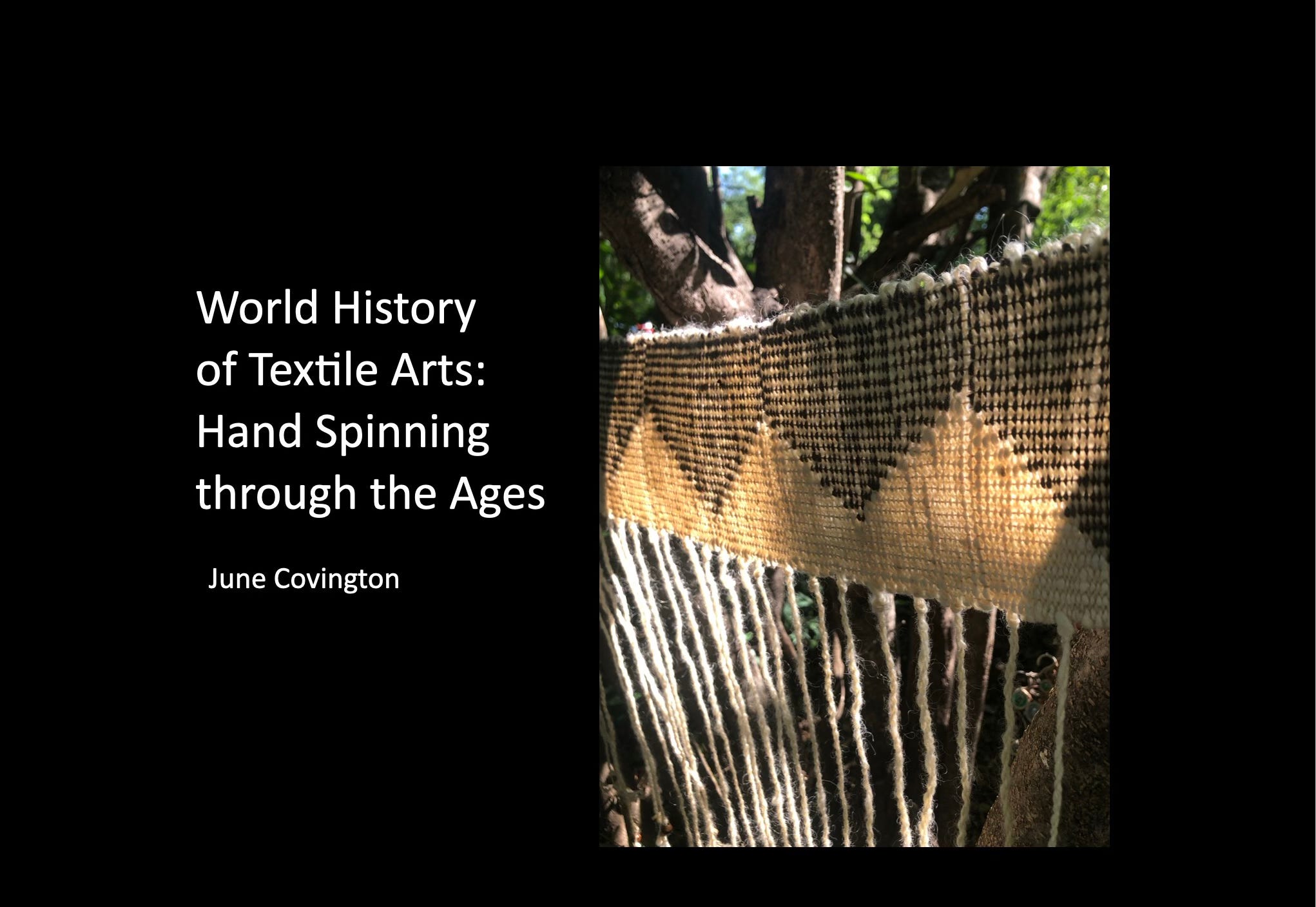
I acknowledge that this title is hyperbolic. Nevertheless, literally every engineering feat known to humans began with the development of String. Using the evidential approach used by Elizabeth Wayland Barber,3 I focused on the String Skirt as the original tool belt.


Then I moved on to the tools used to facilitate spinning. Through out the world, archaeologist have found textile tools particularly whorl and loom weight because these items would have been made from stone or other non-perishable materials.


Archaeologists have also found illustrations, visual evidence of Women’s Work in clay, stone and other materials. Women working with textiles appear in many ancient texts, literary and historical.


I began with a focus on Neolithic and Bronze Age Europe and the Mediterranean taking my lead from Dr. Barber. Then, I shifted the focus to North America, where the history of textile making was similar in every way to that of the Old World. Ancient sites across the Americas have yielded evidence of textile-making well before the rise of agriculture and farming.


I concluded with a very incomplete list of links to people whose work inspires me. And, ended with a shameless self-promotion.


I especially owe an apology to the folks who have continued to pay for a subscription through the lean months. Your continued support keeps me going with research and writing; which means a lot! I plan to offer some kind of tangible gift for paying subscribers soon!
There should be a video soon, I will send you all a link.