
Ceremonial Artifacts at the Museum
For Real!

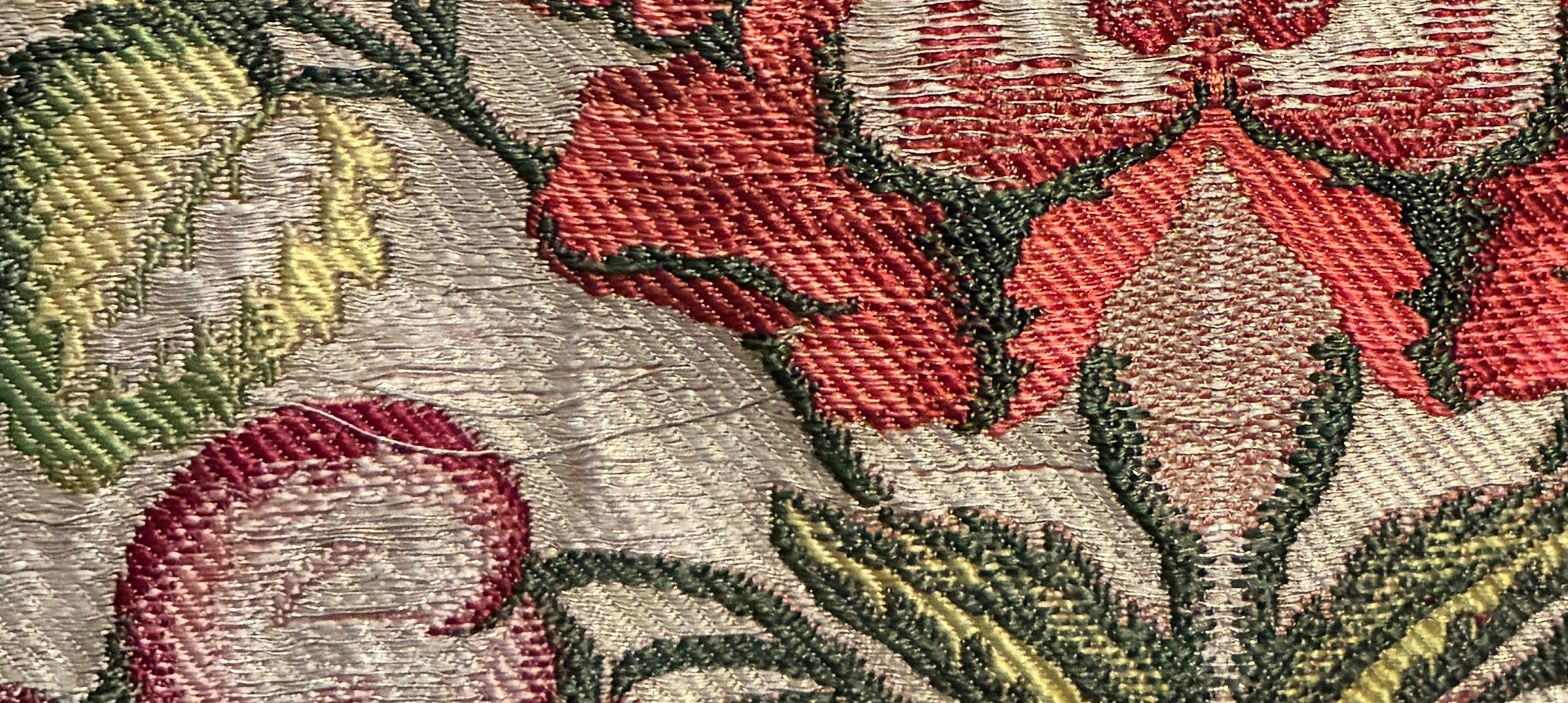


Treasures from the Church of The Holy Specular in Jerusalem
Last week, we went to see this exhibit at the Kimbell Art Museum in Fort Worth. Thankfully, the art-minders didn’t react when I brought my nose right up to the plexiglass case so I could see the individual stitches. I was most excited about the signs of wear and repair, it was clear that these spectacular garments had been made to be used.
These textile masterpieces were designed specifically for ceremony and have been used for countless communion services, maybe not every day, but often enough. I often make snide remarks about museums labeling artifacts as “ceremonial” but in this case, the objects were made specifically to bring gravitas to the ceremonies surrounding church services.
Royal Gifts from all over Europe
The promotional material for the show focused on the silver and gold lamps and other utensils but the space was elevated by the abundance of exuberant vestments. These objects are gifts from Royalty to the Bishop in Jerusalem, costly and very well made. Hundreds of anonymous men, women and children would have contributed to the construction of each piece.
The Breakdown
Because these were made in Europe before the 1800’s (some much earlier) we can assume a few facts:
First, ALL the threads used to make these gems were handspun and hand woven.
Second, the dyes were all procured from plants and minerals, following well established recipes that resulted in centuries of light-fastness and chemical stability. More than likely, the mordants were highly toxic and compromised the health of the dye-workers.
Some of the fabric was complete when it came of the loom, but most of the surfaces were further embellished with embroidery and fringe. The silk threads are remarkably shiny. In fact, many of these objects were layered over hemp and linen base fabrics.
The art of assembling such copious amounts of fabric had to have required whole teams of tailors and sewists. The invention of the sewing machine was still a long way off.


A Room Full of Wonders
I wish I had taken time to zoom out and get a photo of the gallery, which was full of garments which seemed to be standing around waiting for us to leave so they could return to an everlasting procession. If you go to the museum website, you can see a virtual tour of the gallery. It does not do justice to the sensation interrupting a parade.


Long-term Maintenance
The show also included other textiles used in the ceremonies of Holy Communion, tiny pieces used to cover the chalice, altar and other furnishings of the sanctuary. As a life-long member of churches that rely heavily on Altar Guilds, I am familiar with the functions and names. It may seem a little quaint today, but the making and caring for ritual clothing is not a casual endeavor. Respect for the makers, alone, would be reason enough to take good care of them.
I can only imagine how many hands, have carefully cared for each article; cleaning, sorting, and mending. I reckon it is not always a pleasure to care for such massive objects. Over the decades, what kinds of crazy chemicals were applied to these vestments? It would seem, from the appearance of each article, that they have mostly just kept in dust proof storage and careful shaken out. The threads showed no sign of heat or chemical alterations.
Ties that Bind
I am reminded of the moments in Homer’s poems, the Iliad and the Odyssey, when women would bring out beautiful robes as gifts for guests. The time, spent lavishly on the spinning, dyeing, weaving, embroidery, cutting and sewing, would difficult to calculate. All that time and skill was transformed into a priceless whole which conveyed the honor and good will of one house (city, state) to another. These gifts were designed to strengthen bonds between powerful individuals.
This was certainly true for the objects in this exhibit. One thing I really appreciated, was the fact that the aesthetic influence of some of the designs originated with Muslim weavers and designers.
From the Museum Sites
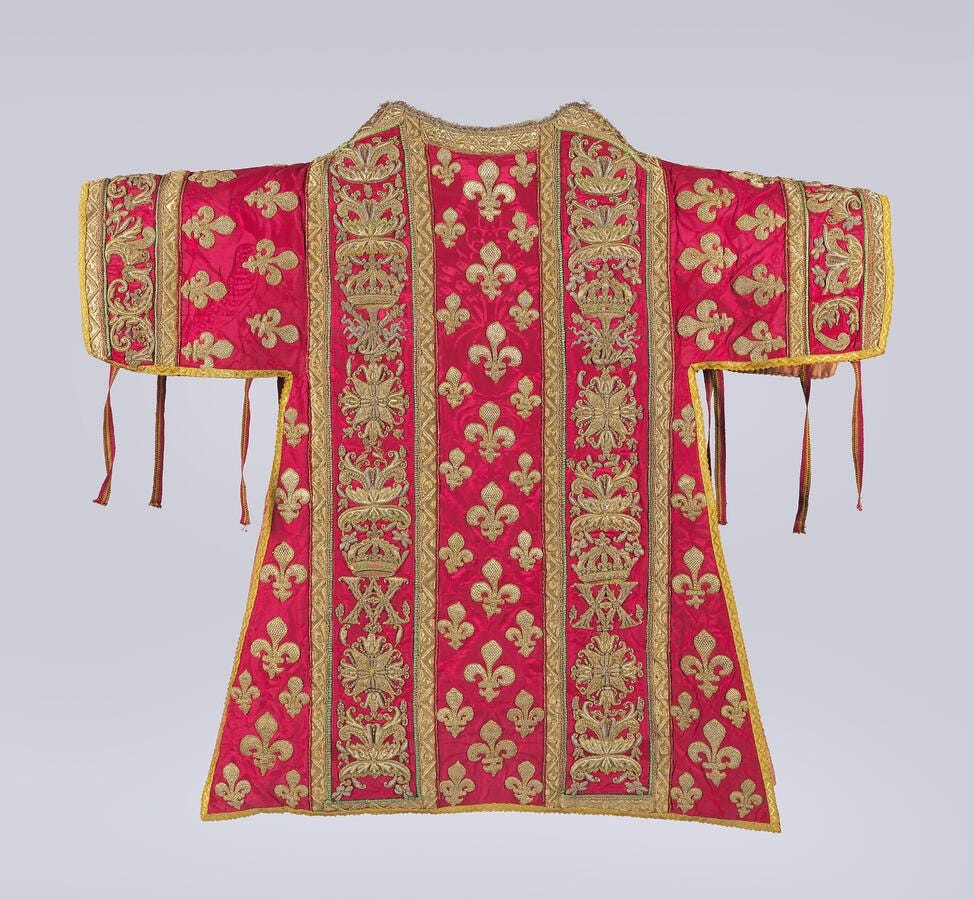
Here is the description from the Kimbell webpage of the red velvet dalmatic shown above by Alexandre Paynet, one of the curators:
“Dalmatic from pontifical set of vestments from Louis XIII, King of France,” 1619, damask and silk satin of crimson red color; embroidery (carried over) in gold (yarn, cord, shiny and curly tinsel), spun silver, silk threads of various thicknesses; flat stitch execution on padding, in relief on large hemp threads.”
Photo by Joseph Coscia Jr.
The Ensemble
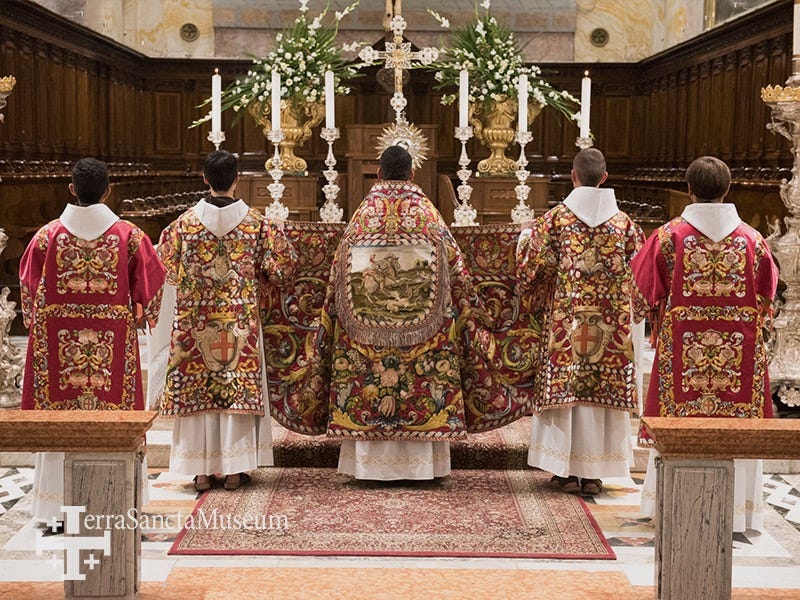
I swiped this photo from the Terra Sancta Museum site, it is the Saint George Chasuble with all its companion pieces.
The Glossary
Vestment; general term for symbolic clothing worn by folks who are part of a religious procession and service, full of symbolism and meaning for the congregation.
Chasuble; “little house” based on the outer garments worn for travel by Late Empire Romans. The original would have been substantial enough to provide shelter from weather.
Dalmatic; Also known as a chasuble for deacons, the middle-men of liturgical services. Interesting fact, the dalmatic was worn by women in the Late Empire Roman era.
Cope; same root as the word Cape, this is a rounded, garment that covers the shoulders of the celebrant.